
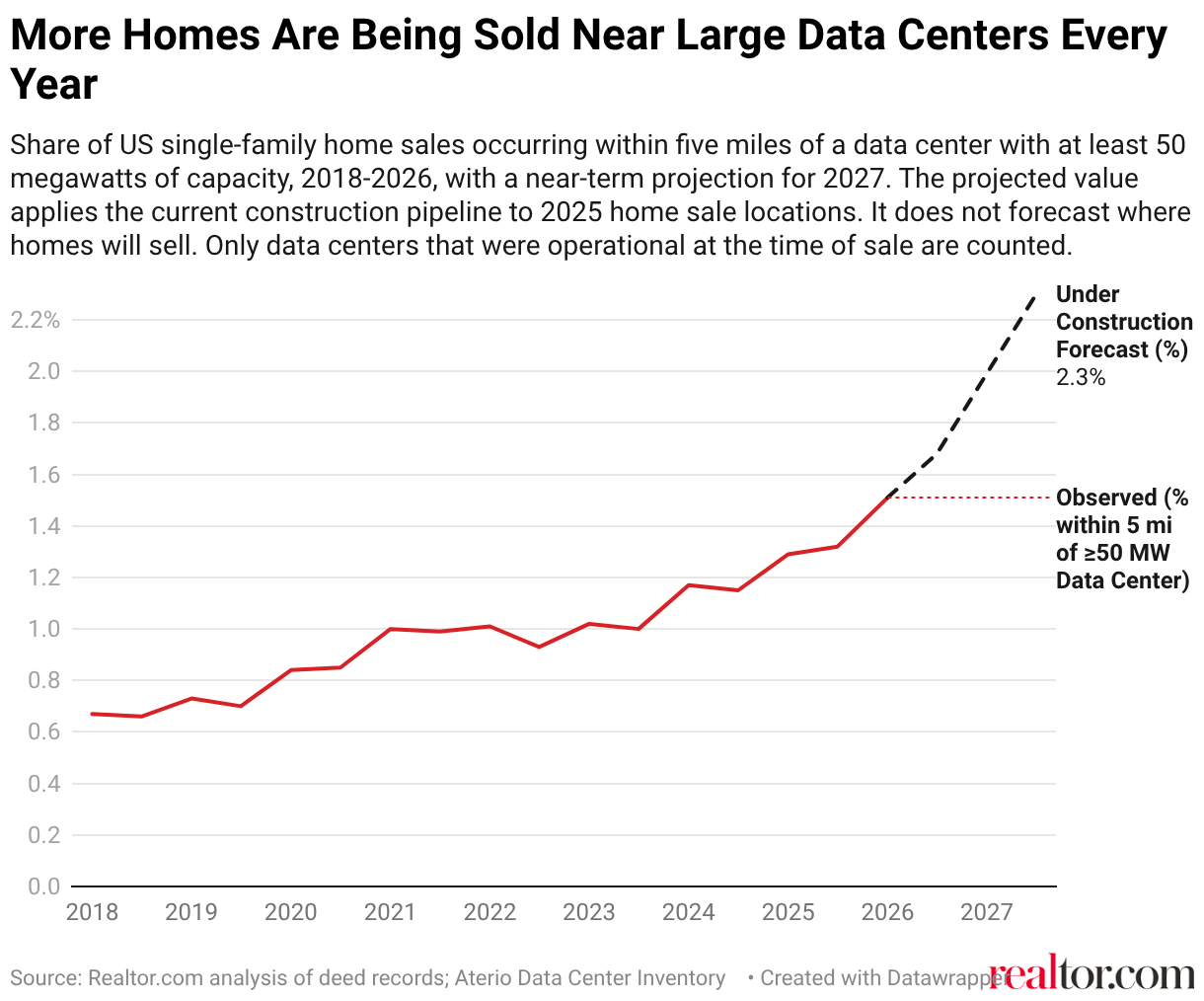
About 1.5% of all home sales now take place near a large data center. That figure has more than doubled since 2018 — and is on track to surpass 2% before the end of 2027, according to new research from Realtor.com.
That’s not because Americans are moving toward data centers, though. Rather, the data centers are moving toward them.
via Realtor.com
How data centers affect housing
In 2015, just 12 United States ZIP codes were home to a large data center, defined as one with a power capacity greater than or equal to 50 megawatts. Now 108 ZIP codes have a large data center, with up to 125 projected to activate before the end of the year.
Lower-income communities are increasingly affected: From 2020 through 2023, ZIP codes with new data centers had above-average median household incomes. In 2026, though, new large centers are largely opening in ZIP codes below the national median income level. That rift will continue to widen in 2027, Realtor.com said.
In Memphis, for example, which is home to the xAI Colossus data center, the median household income is half the national median. Overall, one in eight cities that got a large data center since 2022 have a median household income below $60,000, which is 72% of the national median of $83,730.
via Realtor.com
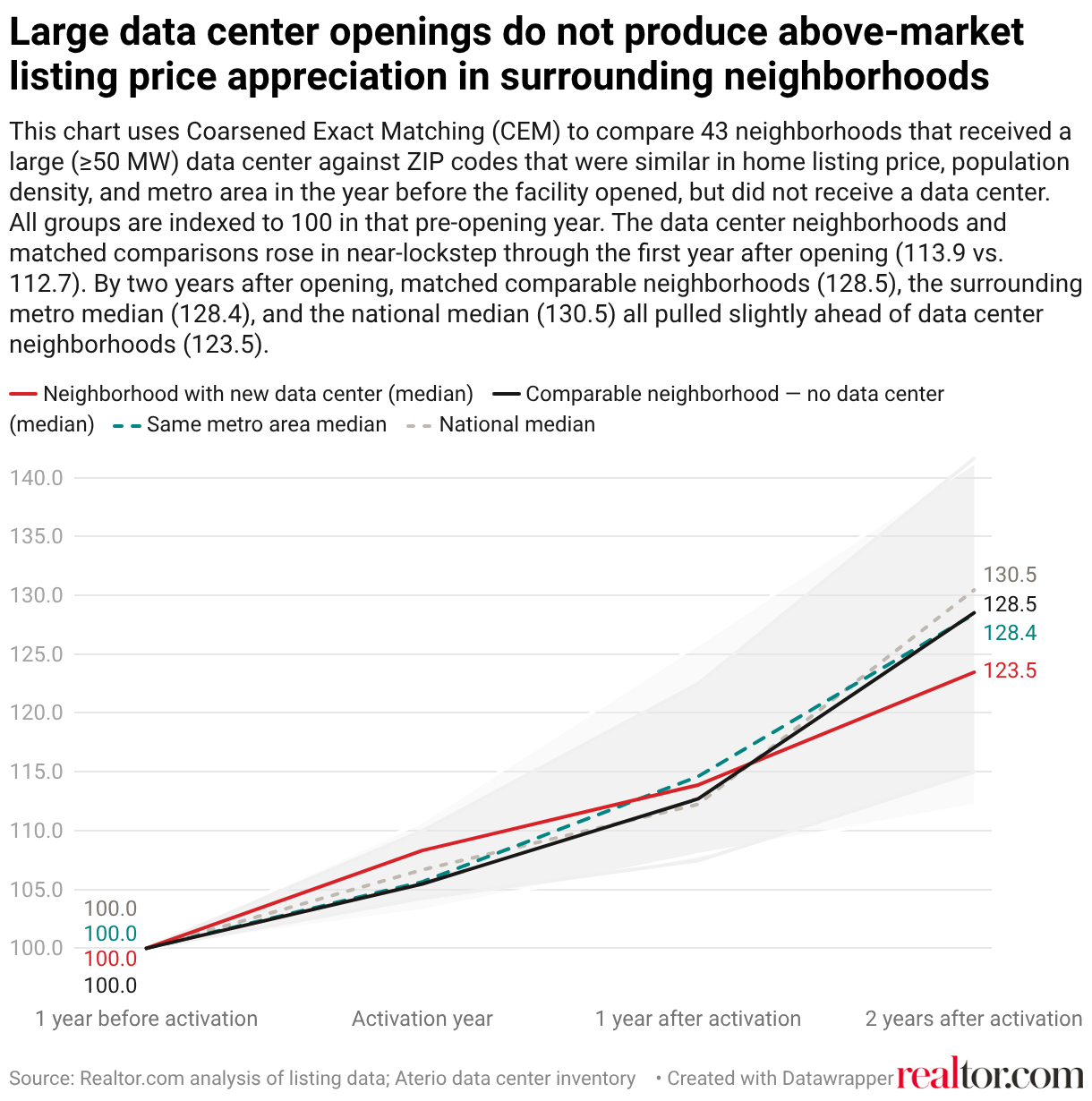
So far, however, the data does not suggest any disparity in home prices or values in communities with new data centers. While neighborhoods are likely to see a 1% bump in home-sale prices in the first year after the construction of a large data center, that effect evens out by the second year. Similarly, list prices experience a small increase in the first year after the opening of a new data center but slightly underperform compared to areas without a center by year two.
“The data center buildout has moved fast and it is raising policy, community and housing-market questions as it spreads and accelerates,” Danielle Hale, chief economist at Realtor.com, said in a press release. “Our analysis so far offers some reassurance: in the communities we studied, a new data center opening nearby wasn’t associated with meaningfully higher or lower home values than similar neighborhoods that didn’t get one. But the facilities coming online next are bigger, more remote and landing in communities with less experience managing an industrial neighbor, so that track record may not hold as a guide to what comes next.”
While home prices seem to be largely unchanged by new data centers, housing inventory is not. Three years after the opening of a large center, ZIP codes retained 66% of their pre-opening active listings, compared to 43% in similar areas without a data center. That could indicate an increase in households wanting to move away from centers.
That increase in listings does not equate to an increase in home sales, Realtor.com said.
Rural areas are bearing the brunt of data center construction
Amid public outcry, many localities have opposed the construction of new data centers: Seattle, Nashville, Cleveland and Durham, North Carolina are among the cities to place moratoriums on new data center construction; Monterey Park, California, banned data centers altogether, and in Effingham County, Georgia — just outside of Savannah — OpenAI was forced to pledge that ratepayers would not feel the effects of increased power capacity after residents noticed increased electricity bills.
As a result, however, many new data centers are cropping up in rural areas with low housing densities. Large centers set to come online in 2027 are located a median of 34 miles from a major urban city center. That’s 26% further than the median distance in 2026. Furthermore, in 2026, the typical large data center is surrounded by 32 housing units per square mile, down from 116 units in 2017 (when just eight centers were activated).
“The places absorbing this next wave of data centers look different from the places that absorbed the last one,” said Economist Intern Glen Morgenstern. “They tend to be lower-income, lower-density and farther from a city center, which usually means fewer resources on hand — fewer attorneys, less organized civic engagement and housing markets that react more slowly to new information. That doesn’t tell us those communities will be worse off, but it does mean they may be less equipped to respond if a facility turns out to be a difficult neighbor.”
As the typical data center grows in power capacity, electricity and water concerns also grow for the surrounding neighborhoods. That pressure is felt most in the Sun Belt, where drought and water shortages already pose a threat to residents.
The effect on property taxes
Property tax revenue is one main incentive for cities to allow a new data center. But does that revenue mean lower tax bills for residents?
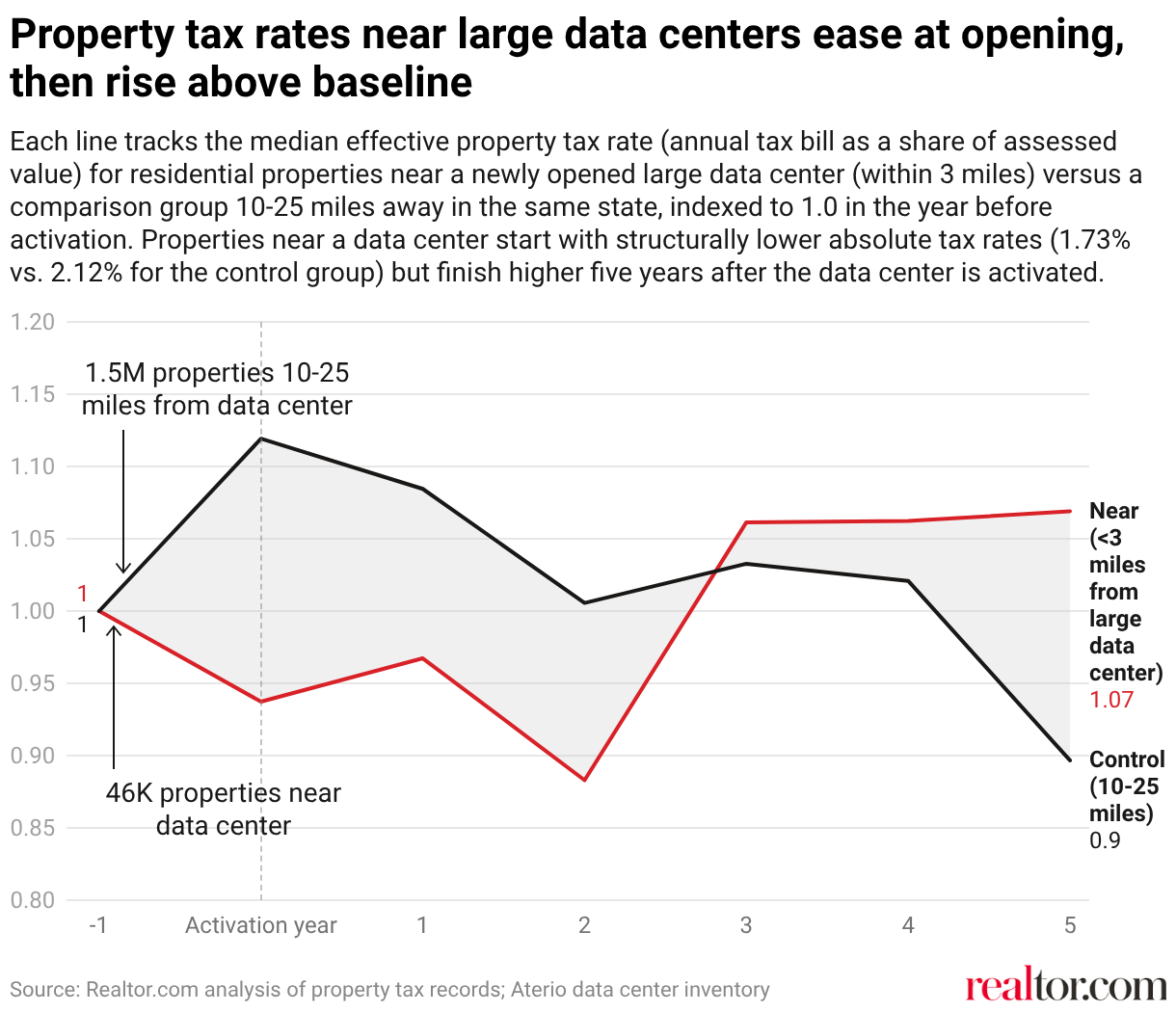
In general, residential properties within three miles of a large center have a median effective tax rate of 1.73%, compared to 2.12% for cities located 10 to 25 miles away. That discrepancy reflects where data centers are being built, though, not any effect on tax rates.
Looking at how tax rates changed within communities with data centers, tax rates softened in the first two years after opening. But after the third year, rates climbed about 7% above the baseline. While that change is small — 1.73% to 1.85% — control groups experienced a decline of 0.22% during the same time frame.
via Realtor.com
“Anyone expecting their property tax bill to fall because a data center opened nearby should not count on it,” Realtor.com said. “The evidence of a direct homeowner tax benefit is weak, and the causal chain between a data center’s presence and a neighbor’s tax rate has too many missing links to draw firm conclusions from this data alone.”