

The entry-level housing market in the United States is faltering while the luxury segment flourishes, giving the country a “K-shaped” market, according to a new report from Realtor.com.
Those factors are making the market look more balanced than it actually is, Realtor.com said.
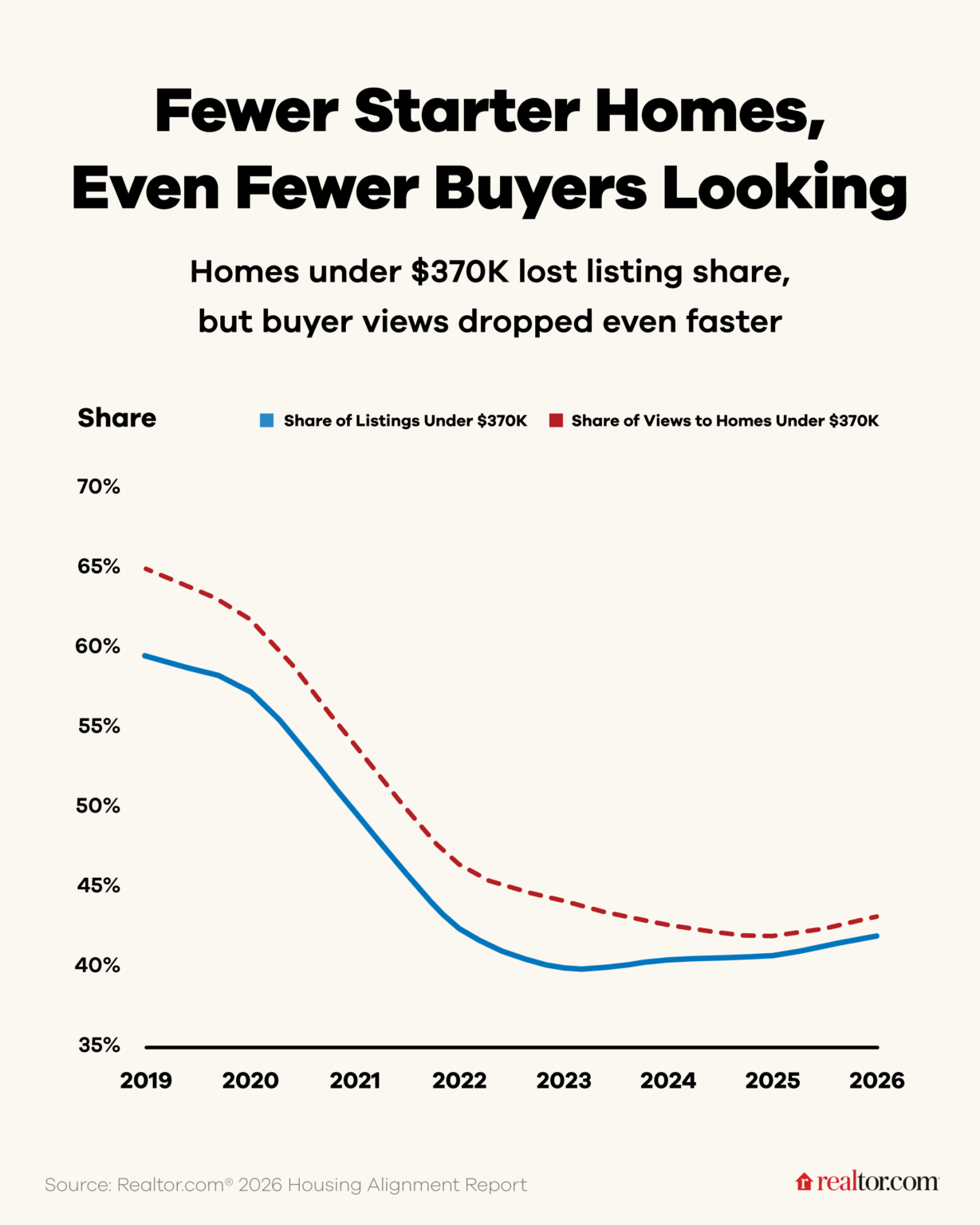
Image courtesy of Realtor.com
Based on online home-shopping traffic, interest in homes priced $370,000 and under fell 11.4 percentage points to 42.8% from 2021 to 2026. In 2021, homes below that price point made up about half of all listings and 54.2% of online traffic. This indicates a trend in which active buyers are looking for more expensive homes, while price-constrained buyers are looking at fewer homes altogether.
“In a typical supply-constrained entry-level market, fewer homes for sale would intensify competition for each listing,” Senior Economist Jiyai Xu said in a press release. “Instead, engagement with lower-priced homes has fallen to its lowest level since 2019. The data suggest that many households who would once have competed for these homes are no longer actively shopping at all.”
Realtor.com called the trend a “K-shaped housing market,” with an upward trajectory for “well-capitalized” buyers and another downward path for households restricted by affordability.
The mismatched market is perhaps best demonstrated by the disparity between median list and sales prices and the median price of homes shoppers view online. In July, the median list price was $428,950, down 2.4% year over year, while the median sales price held steady at $425,000.
In comparison, the median price of homes shoppers viewed online in 2022 was $30,000 less than the median listing price at the time. That same year, entry-level demand far exceeded supply, with homes priced from $90,000 to $300,000 generating views 1.2 times that of typical listings. Now, that gap is narrowing as luxury buyers view — and purchase — homes priced well above the median.
“The market is more balanced on the surface, but that balance is not the same as broad-based health,” Xu explained. “The narrowing gap between listing share and view share at lower price points is being driven in large part by the retreat of price-sensitive shoppers, not by a meaningful restoration of their buying power.”
Overall, Realtor.com said, entry-level demand has contracted while luxury demand has remained strong.
“The change is not a return to a broadly accessible market; it is a more stratified one,” Realtor.com stated. “In fact, an earlier look at housing-supply alignment to market-wide measures of income … confirms that an effective housing shortage remains, concentrated among lower-priced homes for sale.”